





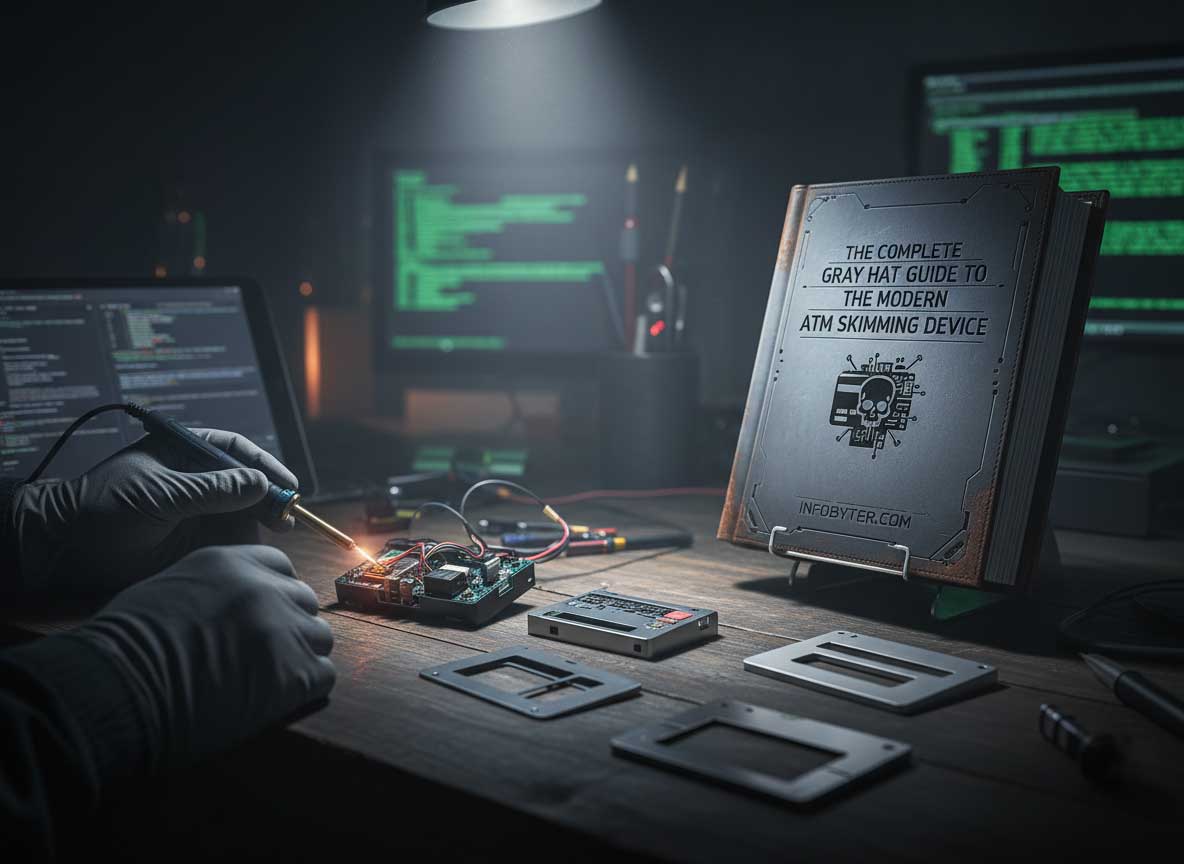
Introduction (ATM Skimming Device)
The modern ATM skimming device is a marvel of underground engineering. It is compact, precise, and designed to operate undetected in plain sight. For those who understand the gray-hat space, these devices represent the intersection of hardware hacking, physical security bypass, and financial monetization.
This guide is for the serious operator. Not the tourist. Not the person who watched a YouTube video and thinks they know the game. This is the complete breakdown of the modern ATM skimming device from the inside out. We cover the hardware components, the deployment protocol, the data monetization pipeline, and the OPSEC required to stay ghosted after the install.


If you are ready to understand how these devices actually work and how to use them effectively, read on.
Also read: Best Dumps with Pin Website 2026
Verified Vendors Shop
Tested. Fully Trusted. Highly Recommended.

Hardware Breakdown: Inside the Black Box (ATM Skimming Device)
The modern ATM skimming device is more sophisticated than the crude overlays of the past. Today’s devices are compact, wireless, and designed to capture both magnetic stripe data and PINs simultaneously.


The Magnetic Read Head
At the core of every skimmer is the magnetic read head. This component reads the data stored on the magnetic stripe of the card as it passes through the device. High-quality read heads are essential for capturing clean track data. Cheap read heads produce errors that result in failed clones.
The read head is positioned to make contact with the stripe at the correct angle and pressure. This requires precise mechanical alignment. Most modern skimmers use read heads salvaged from card readers or manufactured specifically for skimming purposes.
The Microcontroller (ATM Skimming Device)
The microcontroller processes the data from the read head and stores it in memory. Common microcontrollers used in skimmers include Arduino-based boards, Raspberry Pi Pico, and custom PCBs. The microcontroller also manages power consumption and data transmission.


Storage and Transmission
Data is stored on a microSD card in basic skimmers. More advanced units use Bluetooth modules to transmit data in real time to a nearby smartphone or laptop. Bluetooth-enabled skimmers allow the operator to monitor data collection remotely and retrieve the hardware only when sufficient data has been gathered.
Some high-end skimmers use GSM modules to transmit data over the cellular network. This eliminates the need for the operator to be physically nearby during data collection.
Power Source (ATM Skimming Device)
Skimmers are powered by small batteries. Lithium polymer batteries are common due to their compact size and high capacity. The battery must last for the duration of the operation, typically 4 to 8 hours, but sometimes longer.
Power management is critical. The microcontroller must enter low-power sleep mode between card insertions to conserve battery life.
The Enclosure
The enclosure is the physical housing that holds all the components. It must match the target ATM in color, texture, and shape. 3D printing is the most common method for creating custom enclosures. Some operators use silicone molds to create flexible enclosures that conform to the ATM’s contours.


Make money Via Transfer tap in and make up to $10k+ Daily. Follow the Path to success
PIN Capture Components (ATM Skimming Device)
For PIN capture, the device may include a hidden camera or a keypad overlay. Hidden cameras are typically pinhole cameras with wide-angle lenses. Keypad overlays use capacitive sensors or mechanical switches to detect keystrokes.
Deployment Protocol: The Art of the Install (ATM Skimming Device)
Deployment is the most critical phase of the operation. A poorly executed install will be detected immediately. A well-executed install will go unnoticed for hours or even days.
Pre-Install Reconnaissance
Before deploying the skimmer, the operator must recon the target ATM. This involves visiting the ATM at different times of day to assess foot traffic, security presence, and camera coverage. The operator should also note the ATM model and take reference photos for hardware fitting.
Timing (ATM Skimming Device)
The best time for installation is during low-traffic periods. Late night or early morning hours are ideal. However, the operator must also consider cleaning schedules and security patrols.
The Install Process
The installation itself takes seconds. The operator approaches the ATM, attaches the skimmer to the card reader, and places the PIN capture device. The entire process should take no more than 30 seconds.
The skimmer must be aligned perfectly with the card reader. Any misalignment will cause insertion issues that alert the user. The operator should test the fit before finalizing the install.
Verification (ATM Skimming Device)
After installation, the operator should perform a quick verification. This involves inserting a test card to ensure the skimmer reads the data correctly and that the card passes through to the real reader.
Retrieval
Retrieval is the mirror of installation. The operator returns to the ATM and removes the hardware. This should be done quickly and without attracting attention. The hardware is then taken to a secure location for data extraction.
Data Monetization: From Raw Logs to Clean BTC (ATM Skimming Device)
Capturing the data is only half the battle. The real value comes from monetizing that data effectively. This section covers the pipeline from raw logs to clean Bitcoin.
Data Extraction
The first step is extracting the data from the skimmer. For microSD-based skimmers, this involves removing the card and reading it on a computer. For Bluetooth-enabled skimmers, the data can be downloaded wirelessly.
The data is stored in a raw format that includes the magnetic stripe track data and the PINs. The operator must parse this data to match each card with its corresponding PIN.
Card Cloning (ATM Skimming Device)
Once the data has been extracted, the operator creates cloned cards. This requires a card writer and blank cards. The track data is written onto the blank card’s magnetic stripe.
The cloned card must be tested to ensure it works. This is typically done at a machine the operator controls.
Cash Withdrawal
With cloned cards in hand, the operator withdraws cash from ATMs. This must be done quickly to avoid detection. The operator should use multiple ATMs in different locations to minimize the risk of being caught.
Converting Cash to Bitcoin (ATM Skimming Device)
Once the cash is obtained, it must be converted to Bitcoin for secure storage and transfer. This is done through cryptocurrency exchanges or peer-to-peer platforms.
The operator should use exchanges that do not require identity verification. Peer-to-peer platforms are preferred because they offer more anonymity.
Selling Data Directly
Some operators skip the cloning and withdrawal steps and sell the raw data directly. This is a faster monetization method but yields lower returns. Data is sold on darknet markets to other operators who handle the cloning and withdrawal themselves.
OPSEC Post-Install: Staying Ghosted (ATM Skimming Device)
OPSEC does not end when the hardware is installed. In fact, the post-install phase is when many operators make mistakes that lead to identification.
Physical OPSEC
After installation, the operator should avoid returning to the target ATM unnecessarily. Each visit increases the risk of being seen and identified. If remote monitoring is available, use it to track data collection without physical presence.
Digital OPSEC (ATM Skimming Device)
All communication about the operation should be conducted through encrypted channels. Use Signal or Telegram for messaging. Use VPNs and Tor for any online activity related to the operation.
Never use personal devices for any aspect of the operation. Burner phones and laptops are essential.
Cleaning Up
After the hardware is retrieved, the operator should clean the ATM of any fingerprints or traces of the device. This includes wiping down the card reader area and the keypad.
Avoiding Patterns (ATM Skimming Device)
Law enforcement uses pattern analysis to identify skimming operations. To avoid detection, vary your methods between operations. Do not use the same hardware design, the same target locations, or the same withdrawal patterns.
Common Mistakes and How to Avoid Them (ATM Skimming Device)
Mistake 1: Poor Hardware Fit
If the skimmer does not match the ATM perfectly, users will notice. Always test your hardware on the exact ATM model you plan to target.
Mistake 2: Ignoring Cameras (ATM Skimming Device)
Many operators focus on the card reader and forget about the ATM’s built-in cameras. Always check for camera coverage before installing.
Mistake 3: Reusing Hardware
Using the same skimmer at multiple locations creates a pattern that law enforcement can track. Always use fresh hardware or modify your design between runs.
Mistake 4: Cashing Out Too Fast (ATM Skimming Device)
Rapid withdrawals from multiple locations trigger fraud alerts. Space out your withdrawals and use different cards at different times.
Mistake 5: Poor OPSEC
The most common mistake is poor operational security. Using personal devices, discussing operations on unencrypted channels, and returning to the target ATM unnecessarily all increase the risk of identification.
Pro Tips from the Underground (ATM Skimming Device)
- Use a Faraday bag to store your hardware during transport. This prevents remote detection.
- Always test your cloned card at a machine you control before using it in the field.
- Never keep all your tools in one place. If you get caught, you want to limit what they find.
- Build relationships with other operators. Shared intelligence is valuable.
- Study bank security reports. They often reveal exactly what countermeasures are being deployed.
Real-World Applications on ATM Skimming Device
The techniques described in this guide are used by real operators around the world. From Eastern Europe to Southeast Asia, the same principles apply.
One notable example is the use of Bluetooth-enabled skimmers in Latin America. These devices allowed operators to monitor data collection remotely and retrieve the hardware only when sufficient data had been gathered.
Another example is the use of 3D-printed enclosures in Europe. Operators created custom-fit skimmers that matched the exact specifications of target ATMs, making them virtually undetectable.
Summary of ATM Skimming Device
- The modern ATM skimming device is a sophisticated piece of hardware.
- Successful deployment requires careful reconnaissance and precise installation.
- Data monetization can be done through card cloning and cash withdrawal or by selling raw data.
- OPSEC is critical before, during, and after the operation.
- Common mistakes include poor hardware fit, ignoring cameras, and poor OPSEC.
Conclusion of ATM Skimming Device
The gray-hat guide to the modern ATM skimming device is a comprehensive resource for those who understand the game. From hardware breakdown to deployment protocol to data monetization, this guide covers everything you need to know.
If you are serious about operating at this level, you need the right tools and the right information. The resources are out there. The question is whether you have what it takes to use them.
Ready to move beyond theory? For verified, high-quality cards and fullz, visit cvvdump.com or buyccfullz.site. Real data, reliable service, and the tools you need to execute at the highest level.
Also read: Best carding methods 2026 (trending today) in the Darkweb
FAQ on ATM Skimming Device
What is a modern ATM skimming device?
A modern ATM skimming device is a compact hardware unit that attaches to an ATM card reader to capture magnetic stripe data and PINs. It typically includes a read head, microcontroller, storage or transmission module, and a power source.
How do I identify an ATM skimmer?
Look for loose or mismatched parts on the card reader, unusual attachments, or hidden cameras near the keypad. Compare the ATM to others of the same model. If something looks off, it probably is.
What does a skimmer look like?
A skimmer is designed to look like part of the ATM. It matches the color, texture, and shape of the original card reader. Some skimmers are barely visible, while others may have slight color mismatches or protruding edges.
How can I prevent ATM skimming?
Use ATMs inside bank branches where security is higher. Check the card reader for loose parts before inserting your card. Cover the keypad with your hand when entering your PIN.
What is a skimming device?
A skimming device is any hardware used to capture card data without the user’s knowledge. This includes card reader overlays, hidden cameras, and keypad overlays.
How do skimming devices capture data?
Skimming devices use a magnetic read head to capture data from the card’s magnetic stripe. The data is stored or transmitted for later use in cloning the card.
Can skimmers capture EMV chip data?
Standard skimmers capture magnetic stripe data, not EMV chip data. However, shimming devices can capture chip data by inserting a thin device into the card slot.
How do operators monetize captured data?
Operators can clone the cards and withdraw cash, or they can sell the raw data on darknet markets to other operators.
What is the most important factor for success?
OPSEC. The most advanced hardware is useless if you get caught due to a simple mistake. Treat every operation with the same level of discipline.
Is ATM skimming still profitable?
Yes, but the profit margin depends on the quality of the operation. High-quality hardware and strict OPSEC increase profitability. Amateur operations often yield little and carry high risk.
Call to Action on ATM Skimming Device
Ready to move beyond theory? For verified, high-quality cards and fullz, visit cvvdump.com or buyccfullz.site. Real data, reliable service, and the tools you need to execute at the highest level.

Verified Vendors Shop
Tested. Fully Trusted. Highly Recommended.